Monday, 31 October 2022

More of Amy, the performance artist

At Extreme Poses on October 27th.

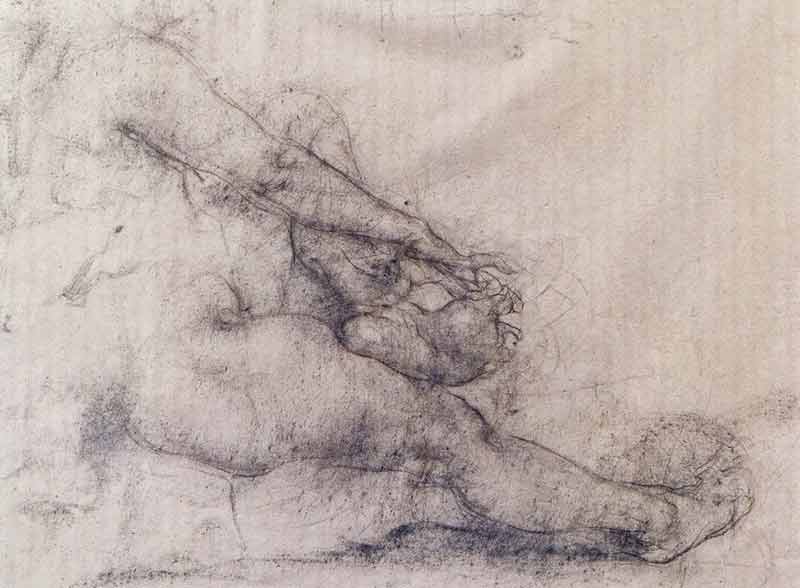
We previously had Amy as our model on June23rd and once or twice before and here she is again providing something very different. A dancer, an acrobat, wearing a leotard, using the ceiling straps the plinth and finally a hoop to present a different kind of pose. 

How did she impact on my approach and on my process, and on what appeared on my paper?

Lets take a look:


Well, they are different. I remarked to Paul and a couple of colleagues during coffee break, after the first three poses, that I felt this morning so far was a bit like hitting a bump in the road after driving along a smooth highway for a long time. I clearly sensed that I had been jolted out of the comfort zone of preceding Thursday mornings. I had anticipated this: see next paragraph.

How did she impact upon my approach?   Right at the beginning did I expect/anticipate a different reaction from myself? Not too sure about this. If I did it may have to do with a 'clothed' model. 

How did she impact upon my process? (i) Less a collage of drawings which are each a study of a selected anatomical part. (ii) Greater equality of contribution to mark-making from both hands.

How did she impact upon what appeared on my paper? (i) no controlled continuous lines. (ii) more movement, less static description.

I did carry out a quick analytical exercise to find out whether the drawings of Amy were different.............

Method: I listed my oft quoted set of terms which characterise my work, and then compared their occurance in, and relevance to, the set of 5 drawings of Amy, with two other sets of 5 drawings from recent Thursdays. The other two were: the model Shelley on September 22nd and the model Paul on October 20th. (these two sets represent a fairly rare event when all 5 drawings have pleased me, most times two or three work well and the others I will dismiss)

The 7 characteristics are: 'morphing', 'superimpositioning', ''overlap', 'transparency', 'different scales', 'cubist', 'spatiality'. Each drawing was examined and a record made of the characteristics which (I felt) were most pronounced, clearly relevant and best illustrated by the drawing. So there were 5x7, i.e. 35 maximum possibles for each model. 

Result: Shelley scored 23; Paul scored 19; and Amy scored 7. 

Conclusion: My responses to Amy were significantly different to both Paul and Shelley. My responses to Amy only in part conform to my recent framework of concepts and techniques. This suggests a revised vocabulary of characteristics could be sought. 

Postscript: I have just completed this posting on the evening of Wednesday, November 2nd. Tomorrow is Thursday and I understand we will have Amy modelling again. Am I preparing for this? As I have said before, I will let the thinking and the self-analysis which has taken place, and recorded on this blog, sink into my sub-conscious in any way it wants to. When I sit at my easel, my virgin A1 white cartridge paper, and Amy, before me, there will be no consciously prepared plan: I will arm myself with two fine-liner pens and somehow, from somewhere, will come a stimulus, and mark-making will commence.


More on spatiality


"ANTOINE DE VILLIERS is a South African artist currently based in Savannah, Georgia, USA. Antoine specialize in emotionally driven abstract and figurative art. She is a veteran of over 70 exhibitions and has lived on 4 continents"

The above is taken from her website. I first encountered Antione's work way back in about 2010. I loved it so much I emailed her and we exchanged a number of conversations. As I noted in my previous posting I have just re-accessed the work of Kristina Laurendi Havens and discovered a quote of hers which relates to an issue I have taken a interest in exploring.

Here is another connection, this time with Antoine, and this time to do with the subject of 'spatiality'. I have many times talked around the huge subject of 'perception' and 'perceptual processes', and how we each see differently from each other and therefore think differently about what we are seeing and so draw differently. The complexity of the perceptual process takes place within the physical space that is created between the artist and the model, and this is added to by the space within, around and beyond the paper or canvas. For me there is the additional dimension of spatiality contributed by my being an architect.

Here below I have taken a quote from Antoine's website which introduces a series of her works. And what is so amazing is that she too is placing emphasis on what takes place both within the space of our individual mental processes and the spatial relationships of artist and model. She quotes Frank Lloyd Wright who was one of the first architects from whom I gained inspiration and a philosophy I took on board in my early days as a student of architecture and has been with me ever since, so her analogy is all the more pertinent and relative to my own research and discoveries about my art.


THE SPACE WITHIN

A response to our isolation and the challenges resulting from the pandemic as well as our longing for connection and intimacy. The series reflect on the space within our minds and thoughts as well as the space within the relationships.

‘The space within becomes the reality of the building’ -Frank Lloyd Wright

 So, I am regularly drawing the human body but having a far less interest in the final outcome of what appears on my paper than in the process I am part of in the making of the drawing. Hence my claim that I am 'a process artist'. I operate within a process and am fascinated by that process and I wish to enhance the depth, quality and my understanding of process. (Of course, I get great satisfaction when I and others can celebrate a 'physical' drawing outcome). Just like when a building looks good, has quality materials and detailing, fits in well etc., etc., BUT what is the aspect of a building that must work? What is the ultimate criteria for judgement? What is it that becomes the reality of the building? The answer lies with the user. Buildings are made for people to live, work and play in. If it does not work for the user then what is the point. It is the space(s) that the user experiences and uses, the space(s) that the user senses, perceives and interprets. Ultimately architecture is a spatial experience.

I have said before that thro' life-drawing I have discovered and engaged with spatial issues and the complexities of spatiality and spatial thinking which I feel are different and sometimes quite new to me compared to the way I perceived, understood and used them when practicing and teaching architecture. Would my architecture and my teaching of architecture been any different if I knew then what I know now? It's all part of a learning experience. My drawings are what they are due in part to my past.

More on variables and parameters

I first mentioned Kristina Laurendi Havens back in 2010 as an artist whose work fascinated me at the time I was starting to explore the world of life drawing. It was particularly her use of colour and her expressive figurative work that attracted me. I recently re-accessed her website to discover that she had made an observation about an issue which I have been very interested in and one I have posted some thoughts on a number of times. It is about becoming aware of the numerous variables that come into play to influence one's art and how one can introduce constraints or parameters to help guide one's process. 

My most recent comment on this was my posting of October 13th 2022 (Context: the variables influencing a life-drawing response). Here is what Kristina had to say:

There's a million ways to paint an apple.  An apple.  Think about it.  You could paint an apple in any color of the rainbow.  Paint it cut in half.  Paint it rotting on a cutting board.  Paint it in a basket.  Paint it in shadow.  Put in under a spotlight.  Paint it abstract.  Paint it in black and white.

You see where I'm going with this?

SO many choices.

If you were told "go paint an apple!"

Would you know what to do?

Would you know what surface you want to paint it on?

What brush to use?

What palette to use?

What medium to use?

What would you want to SAY about the apple in your painting?

Those are the questions the Artist has to answer before they even pick up a brush.  And it's in those questions where frustration can sneak into the studio.  I HAVE TO MAKE SO MANY DECISIONS JUST TO MAKE A PAINTING.

So, the practice - the act of practicing painting - can be frustrating if you don't work within a few parameters.

What makes practice practical? What makes practice rewarding, so that you want to practice MORE?

Rules.  Parameters.  Parameters are your friend.


You will recall my current 'material/physical' parameters are: 220gsm white cartridge paper in portrait format, a fine-liner pen in each hand, sitting at my easel. Occasionally I adopt a different medium, but I resist the frequent suggestions from my colleagues to break into paint and colour (look back to early postings to see how I enjoyed pastel, conte, coloured inks, tinted charcoal, sometimes paint, etc.) As I have mentioned a few times over recent years I believe my work changes, almost week by week. It is an evolutionary change process, sometimes (or probably most times) the differences may be imperceptible to the eye of many beholders. However I strongly believe that my highly constrained material/physical parameters do allow me to focus on 'my process' and on a deeper engagement with 'my feelings', 'my intuition', 'my spontaneity', 'my emotion', 'my meditation', 'my sub-conscious', 'my looking and my seeing', etc.,  etc.,


Monday, 24 October 2022

I have a feeling to change momentum in my journey.

Not sure why. However:

I love what is occurring in my drawings,

Each week my evolution continues,

Each week, Paul and I note something different, and often, new.

But, as my art of life-drawing elevates its role in my sense of well-being, perhaps it could elevate its contribution.

One way is for me to increase my understanding of the process I am part of. So, here are a few insights which may help. They tend to focus on 'perception' and particularly on how I might see things from within myself, and how this may influence what appears in my drawings.

An early insight (source not recorded) 'we do not see things as they are, we see things as we are'.

Jonathan Swift: 'vision is the art of seeing what is invisible to others'.

James Hillman: 'by seeing differently, we do differently'.

John Paul Caponigro: 'looking and seeing are two different things',

George Monbiot: 'what you see is not what others see'.

James Turrrell: 'I want you to sense yourself sensing - to see yourself seeing'.

I  really warm to this final quote as it pushes this whole preoccupation with the subject of perception back into the self. The previous quotes are all about how one individual sees differently to everyone else around them. How one does see differently and can therefore deliver diverse and challenging images. 

Can we help this process along? How can an individual change momentum and take a leap into the future? How can an individual adopt the philosophy: 'Paths are made by walking'


It's October 20th over at Extreme Poses. Such a frustrating drive from Wales over into England across the Severn Estuary, 40 miles, heavy traffic, diversions......but Clarissa and I arrived in time to set ourselves up with five minutes to spare before Paul Boon took up his first pose. Quite a crowded studio, numbers are picking up as we enter the late autumnal restrictions on other activities. Lots of chat at the start, then an ambiance of quiet concentration and devotion to the act of life-drawing takes over. 30 minutes for the first pose, Paul re-imposes and then silence again for the second pose. Following the third 30 minute pose we take a half-hour coffee break: people intermingle, talk over each others drawings, chat with the model, feedback from colleagues is sought, the learning-community of life-drawers continues, and Paul Fowler our mentor is drawn into individual intimate and private conversations. Two 30 minute poses follow, and these complete the morning session. We all help to stack the easels, boards and tables, and say "Thanks Paul (and Paul): See you next week"

When I arrive home, if the sun is in a blue sky I will set up my drawings outside, photograph them and post them on this blog, usually with a comment. More often I will awaite posting until I have researched around my outcomes.


My drawings from October 20th will be posted soon.

October 26th and here they are. All are of 30 minute poses, drawn with a fine-liner pen in each hand, on 220gsm cartridge paper:


Friday, 21 October 2022

Talking it over

 I really enjoy meeting up and talking over drawings in between poses:


Monday, 17 October 2022

Nicolai Fechin in detail

Noted in my previous posting the early influence of the drawings of Nicolai Fechin and the three I showed recalled the influence of drawings of the whole figure which is what I was attracted to at the time. Just come across others of his work which zoomed into hands and feet. Did I look at these at the time? I can't recall. But it is fascinating to place alongside each other some hands and feet:

Nicolai Fechin - 1881 to 1955


Bob Fowles - 1942 to  'still-going-strong'


Thursday, 13 October 2022

An early inspiration

I must never forget, 

and never will forget, 

the early fundamental impact 

of the drawings of Nicolai Fechin:

"No one can teach you how to paint and how to draw except you yourself. You cannot learn how to paint by watching a well-trained master painting, until you yourself, have learned how to paint with some understanding first. Only by the path of much practice and experience can mature results be reached."

After something like 16 years of life-drawing I am really enjoying the mature outcomes from my practice and experience, in the forms of both 'process' and 'product'.

Drawings of Nicolai Fechin that inspired me................

Nikolai Fechin - Russian Figurative Master. 1881 - 1955


FechinNudeStudy.jpg


Image


Context: the variables influencing a life-drawing response

One can have a plan: Today I will try to build upon last weeks achievements; or I will develop further my squiggle technique; or I will attempt to engage with much greater anatomical detail; or I will further explore levels of transparency and overlap and superimposing; etc., etc.

BUT plans are never fulfilled. Why? Because there are numerous variables, which can be anticipated to impact, but when they do they come as a surprise and so disrupt any pre-conceived plan.  

I have attempted to control these unwanted and unexpected impacts by defining my own controllable parameters: A1 white 220gsm cartridge paper, portrait format, a fine-liner pen in each hand, sitting at my easel. 

I have talked of these variables before on this blog: how I am feeling both within myself and with life in general; the journey over to the studio; how much I have looked at my recent works and the extent of my self-analysis; the model, and how they present themselves; the ambiance of the studio; etc.,etc.,

This morning followed on from a week during which I have been coming to terms with my final decade on this earth. Six months on from my 80th birthday I have entered a period, not only of reflection, but of anticipation of the decade ahead. 

The global context of extreme climatic changes, massive population growth, increasing economic and climatic migrations, wars and social inequality, these and many other issues I find I am placing alongside my own self-centered concerns about my health and my increasing awareness that my body and my mind is changing. Most of the time I feel I can handle all of this through my chosen way of how and where and with whom I live. I then have the added bonus of life-drawing!

It was very much against this background which I have outlined above that this morning's drawings emerged. I am not claiming that a revolution occurred. I am not claiming they surpass anything I have produced before. But Paul Fowler did observe a 'freedom' and an 'enjoyment' in the process he was seeing. 

Take a look and see what you think. I believe Paul hit the nail on the head: it was how I felt. I was carefree in my attitude in my response to each and everyone of Shelley's amazing poses.


Wednesday, 12 October 2022

Some thoughts on drawing with both hands simultaneously

 'Conceptual Integration'- this is a term I have come across to describe when I perceive and prefer to think of the operations of my two hands not as separate activities but as a single activity. However, it may be that in my two-handed activity I am distracted from the task in hand by attempting consciously to co-ordinate and integrate my two hands, and in so doing I am inhibiting my perceptual and cognitive processes and thereby reducing the 'quality' of the product of the drawing process. 

Here are some questions which arise when I start enquiring into my two-handed drawing process: Are two hands faster than one hand? Do I map out my initial response quicker (or differently) by using two hands? Do I delve deeper into the pose, and do I see things sooner, with two hands?

I have read that "the advantage of two hands becomes more pronounced when the task becomes more difficult"  How does one judge 'difficulty' in a life-drawing situation? Can I set/decide upon the degree of difficulty myself? Do I do this by electing what to draw? Where to start? Which anatomical part attracts?

When I was well into my two-handed process Paul Fowler observed that the marks from the mark-making of my left hand were much more 'lyrical' than those from my right or skilled dominant hand. So, it would seem that unless one is purely ambidextrous, if you are going to draw something with your non-dominant hand you have to think about it more, you have to focus a degree of concentration upon it. By contrast the right hand is responding, in a skilled way, which may be described as a sub-conscious and intuitive response.

I am unsure as to where this analysis takes me. I feel it is important to attempt an understanding of my technique but I am going to resist a scientific enquiry into my art. What I do know (from my past experience of compiling posts on this blog) is that any reflection/questioning/self-analysis which I do will be beneficial as it will nudge my art along its journey [paths are made by walking].

Looking to the next time I draw

 Is this very recent drawing a departure which could herald a new direction? I don't think so.


Tuesday, 4 October 2022

My early 'squiggle' work

Two examples of experiments during the earlier years in my my life-drawing journey.

In both these 'squiggle' drawings the points of my pens or pencils worked closely together on the surface of the paper equally contributing to the mark-making process. I recall that no final concept or form was anticipated and the composition of morphed parts simply emerged and evolved at random in the early stages. I am sure that about half-way through the time of doing the drawings when it was becoming clear of the direction that the drawing was taking then this was helped on its way by conscious compositional thoughts.


August 2013. A male and a female model posing together for about an hour and a half. Selected parts morphed together with a fine-liner pen in each hand.


February 2014. Selected parts from a single pose morphed together with HB pencils, one in each hand.


Monday, 3 October 2022

The essence of my art


Every so often I come across one of my drawings which marks a threshold in my life-drawing journey. This comes about because I am able to delve into my blog's record of drawings, think about them, reflect on them, recall my special moments, and so highlight their special qualities. I could take a number of my works to illustrate this achievement, but for the moment let us look at this one.

The model is Paul Boon, posing within a matrix of  suspension straps and a plinth at Paul Fowler's 'Extreme Poses' at Pegasus Art in Stroud.

He is holding on to a ceiling strap with his left hand. Leaning away, a diagonal takes a line across his shoulders, from which his right arm dangles down into space. 
This diagonal line and direction of force is the essence of the pose. And this is what I first responded to and became the stimulus for my early marks on my paper.
However, we also see that the plinth has a part to play in the formation and energy of the pose.
The mid part of the body has to be supported in some way. This is provided by the structure of the left leg which has its foot firmly stood on the plinth, and its lower leg and ultimately its knee and upper thigh announcing the vital part it is playing in the structure of the pose.

Here are TWO drawings. One: the diagonal of the line of the two arms, from top left to bottom right in the composition. Two: the huge thigh with the leg supported on the plinth and the foot with its toes curled over the edge.

These two drawings are superimposed. They are at different scales. In this way perspective is achieved, foreshortening and advancement is enhanced, and spatiality is celebrated as the ultimate achievement.